The Line Group Ltd
Michael McLeod
Director
Analytical Paper
Influence Warfare Beyond Narratives: Cognitive State Manipulation in the Attention Age
Course context: This paper was originally written by Michael McLeod as his first paper for The Academy’s Executive Certificate in Influence Warfare, taught by Dr Howard Gambrill Clark and Dr Elena Taube Bailey.
Introduction
This paper examines influence warfare through a mechanistic cognitive lens. Traditional approaches emphasise narratives, networks, trust, propaganda, and psychological operations. However, contemporary information environments reveal a deeper layer of competition: the modulation of attention, uncertainty, identity, and cognitive state.
In algorithmically mediated environments, information is continuous, personalised, and optimised for engagement. Under these conditions, influence is no longer limited to persuading individuals to adopt specific beliefs. Instead, influence increasingly shapes the conditions under which beliefs are formed, reinforced, questioned, or abandoned.
The central proposition of this paper is that influence warfare may be better understood not merely as a contest of messages, but as a contest over perception, attention allocation, uncertainty management, and predictive processing. Narratives remain important, but they operate within broader cognitive systems that determine how individuals process information, construct meaning, and make decisions.
This paper proposes that cognitive state may be understood as the operational unit of influence, with predictive processing providing a useful framework for understanding how influence becomes perception and behaviour. From this perspective, the management of cognitive state under conditions of continuous information exposure emerges as a key dimension of modern influence operations.
Building upon the course's five pillars of narratives, networks, subconscious processes, limbic mechanisms, and subtlety, this paper proposes a systems-oriented framework for understanding how influence increasingly operates through cognitive state management. Drawing upon concepts explored throughout the course, this paper examines how foundational narratives, networks, uncertainty, attention, identity, and emerging technological systems interact to create new opportunities and vulnerabilities within the influence domain. It further argues that future influence competition will increasingly focus on shaping cognitive environments rather than merely disseminating persuasive messages.
Definitions for Practitioners
Before extending the argument, several terms need plain operational definitions. This is especially important for commanders, planners, analysts, and institutional leaders who may not need the full neuroscience but do need to understand what is being claimed, what is not being claimed, and why cognitive state matters in practical influence environments.
| Term | Working meaning | Operational use |
|---|---|---|
| Cognitive state | The brain-body operating condition that shapes what a person notices, trusts, fears, remembers, ignores, and is ready to do. | Explains why the same message can produce different behaviours under stress, fatigue, outrage, belonging, or calm. |
| Cognitive state manipulation | The deliberate shaping of signals, environments, tempo, narratives, stressors, social cues, or uncertainty to shift that operating condition. | Moves analysis beyond persuasion toward the management of readiness, salience, threat, trust, and action. |
| Influence signal | Any detectable cue that can alter perception, meaning, emotion, identity, trust, or behaviour: words, images, humour, rhythm, timing, omission, social proof, or visible consequence. | Treats influence as more than message content; the delivery environment is part of the signal. |
| Modulation | A measurable change in the brain's operating pattern; not necessarily more activity, better performance, or conscious awareness. | Allows careful discussion of altered processing conditions without claiming mind control. |
| Operating regime | The current pattern of coordination, variability, stability, and adaptability in neural and behavioural activity. | Provides a bridge between EEG findings, attention, uncertainty, and operational behaviour. |
| Attractor | A state or pattern the system tends to occupy, return to, or stabilise around. | Helps explain why repeated narratives, emotions, and identities can become default interpretations. |
| Flux | The amount and abruptness of movement between states over time. | Useful for describing whether a person or group is making large unstable jumps or smaller regulated adjustments. |
These definitions do not imply that influence operators can precisely control individual brains. They provide a practical vocabulary for describing how information environments can bias the conditions under which perception, judgement, and behaviour emerge.
Mechanistic Frame: Environment to Plasticity
The working model for this paper is: Environment -> Signal -> Governor -> Actuator -> Plasticity. It treats influence warfare as a control problem inside adaptive biological systems. The environment includes the algorithmic, social, cultural, and physical conditions in which a population lives. The signal is not only a message, but any pattern of words, images, sounds, timings, symbols, social cues, or omissions that can be detected by the nervous system. The governor is the set of attention, salience, prediction, limbic, default-mode, and executive-control systems that decide what matters, how uncertain it is, and what it means. The actuator is behaviour: sharing, silence, voting, protest, compliance, hesitation, aggression, trust, or withdrawal. Plasticity is the longer-term reweighting of memory, habit, identity, expectation, and network connectivity.
| Stage | Cognitive mechanism | Influence implication |
|---|---|---|
| Environment | Algorithmic feeds, social norms, institutions, stressors, sleep, tempo. | Shape the conditions under which signals are encountered. |
| Signal | Language, images, humour, rhythm, threat cues, identity cues, repetition. | Deliver meaning through sensory and symbolic channels. |
| Governor | Attention, salience, prediction error, limbic arousal, executive control. | Select what becomes important enough to update the model. |
| Actuator | Speech, sharing, avoidance, compliance, protest, violence, loyalty. | Convert state into observable behaviour. |
| Plasticity | Memory consolidation, synaptic weighting, habits, identity reinforcement. | Alter future thresholds for perception and action. |
However, perception, attention, threat response, emotion, and learning are implemented through electrochemical signalling, neurotransmitters, receptors, oscillatory synchronisation, synaptic plasticity, glial support, and embodied physiology. A narrative is therefore never merely social. It is social meaning executed by biological machinery. Predictive processing and active inference are useful because they connect perception, uncertainty, attention, action, and learning within one operational model (Friston, 2010; Clark, 2013; Bastos et al., 2012).
Foundational Narratives and Predictive Models
Foundational narratives are best understood as generative priors: deep stories that organise what a person or society expects reality to mean before conscious deliberation begins. They are not simply slogans, myths, or propaganda lines. They are compressed models of history, threat, identity, legitimacy, duty, betrayal, suffering, and hope. Once a narrative becomes familiar enough, it may no longer be experienced as a belief. It becomes the background against which other beliefs are judged. In this sense, a chosen narrative can become invisible through repetition, ritual, education, media, and social reinforcement.
The course's five foundations - narratives, networks, subconscious, limbic system, and subtlety - map cleanly onto the mechanistic model. Narratives provide the predictive template. Networks determine how signals travel and where trust is already located. The subconscious performs continuous regularity extraction beneath conscious analysis. Limbic and salience systems attach survival value to threat, disgust, shame, trust, and belonging. Subtlety reduces defensive awareness, allowing influence to operate as environment rather than as overt persuasion.
This helps explain why effective influence campaigns often activate existing structures rather than invent new ones. China can invoke humiliation, sovereignty, anti-racism accusations, and civilisational pride because those frames are preloaded within domestic and diaspora narrative landscapes. Iran can frame external pressure through resistance, martyrdom, anti-imperialism, and religious-political sovereignty. Russia can activate narratives of Western hypocrisy, moral decadence, traditional values, and NATO encirclement. North Korea's external operations are less mass-narrative based but still rely on identity manipulation: false professional identities, remote-work trust, and institutional assumptions about competence and location.
The strategic implication is that analysts should spend less time asking whether a message is persuasive in isolation and more time mapping the narrative topography beneath it. What sacred values are already present? Which humiliations remain emotionally available? Which hero and villain archetypes recur? Which institutions are trusted enough to carry signals? Kautilya's discussion of sowing dissension and Genghis Khan's use of external storytellers both point to a durable principle: the most powerful narrative is often the one the target network tells itself.
Attention as Strategic Terrain
Attention is not a passive spotlight. It is a limited biological control system that selects which parts of the environment receive processing priority. Dorsal attention networks support goal-directed selection, ventral and salience systems help interrupt attention when something appears important, and executive networks attempt to maintain task control under competing demands (Corbetta & Shulman, 2002; Menon & Uddin, 2010).
Influence warfare exploits the gaps between these systems. A target may consciously attend to humour, outrage, novelty, or social reward while the brain continues to extract associations, emotional contexts, identity cues, and repeated pairings from the wider signal stream.
This is why the attention age is different from the broadcast age. Persuasion once depended heavily on crafting a message and pushing it through a limited number of channels. Algorithmically mediated environments reward whatever captures, retains, and recycles attention. The strategic object is therefore not only belief, but attentional allocation. If a population can be made to attend continuously to corruption, betrayal, humiliation, criminality, decadence, invasion, or existential danger, its predictive models begin to update around those categories even when individual claims are later corrected.
Russia's alleged 2024 use of covertly funded U.S. influencers through the Tenet Media case illustrates this terrain. The operational value was not only the content of each video, but the use of already trusted attention nodes inside domestic networks. China-linked Spamouflage activity likewise shifted from low-quality pro-China spam toward accounts posing as Americans and commenting on U.S. political tensions. Iran-linked election activity and Gaza-related content attempted to ride existing emotional currents rather than create them from nothing. In each case, the target was partly attention routing: place the cue inside the feed, attach it to identity, and let authentic users amplify it.
Attention capture also lowers defences when the conscious frame is entertainment. Satire, meme warfare, mockery, and humour can convert political hostility into shared participation. The viewer's defences may be lower because the apparent purpose is amusement, but the signal still trains associations: who is ridiculous, who is contaminated, who deserves disgust, who belongs, and who should be punished. The strategic question becomes: what did the target repeatedly attend to, and what did the brain learn while attention was occupied elsewhere?
Uncertainty as an Influence Multiplier
Predictive processing frames the brain as an adaptive system attempting to reduce uncertainty by updating models of hidden causes in the world. The brain does not wait for perfect evidence. It continuously balances incoming signal against prior expectation, emotional salience, bodily state, and social context. This makes uncertainty a strategic resource. An influence campaign does not need to persuade a target of one settled conclusion if it can destabilise confidence in the process by which conclusions are formed.
Uncertainty works because it increases cognitive load and makes simple explanatory frames attractive. If a population is placed in a state of danger plus perceived lack of control plus perceived lack of competent leadership, the result may be helplessness, cynicism, conspiracy thinking, or desperate attachment to any narrative that restores coherence (Freedman, 2013). In this sense, silence by leaders during crisis can become an internal influence campaign by omission. The information vacuum becomes an environmental signal: no one is in control, no one can be trusted, and hostile explanations may be more predictive than official reassurance.
Recent Russian election-related operations show the operational use of uncertainty. Fake videos about ballots, migrant voters, or bribery do not need to survive fact-checking forever. They only need to produce a short-lived state in which audiences feel the election system is opaque, corrupt, or impossible to verify. Iranian hack-and-leak activity similarly blurs the boundary between authentic material, selective release, forged context, and strategic timing. North Korea's remote IT worker schemes exploit uncertainty in professional identity: if remote work, digital documents, and video interviews are accepted as sufficient trust signals, the adversary can become the employee.
At the molecular and cellular levels, uncertainty is not abstract. Stress physiology changes attention, memory consolidation, sleep, immune function, and threat sensitivity (McEwen, 2007). Neuromodulatory systems such as noradrenaline and dopamine help regulate vigilance, salience, reward prediction, and behavioural updating. The strategic point is not that adversaries precisely dose neurotransmitters. It is that information environments can keep bodies in states of vigilance, agitation, fatigue, or reward-seeking, and those states alter how evidence is processed.
Algorithmic Amplification, Reinforcement and Synchronisation
Algorithms make influence warfare adaptive. They observe behaviour, rank content, test engagement, and return more of what appears to hold attention. This creates feedback loops between biological salience and machine selection. Moral outrage, threat, disgust, novelty, and identity conflict are not always promoted because a platform seeks political outcomes; they are promoted because they reliably generate attention. The result is a reinforcement environment in which users become both targets and actuators.
The central mechanism is synchronisation. When many individuals encounter similar cues in compressed time, emotional and interpretive states can align across a network. Hashtag storms, short-form video trends, influencer cascades, Telegram channels, WhatsApp groups, and state media echoes can make a frame feel socially real before it is analytically verified. The signal becomes credible not only because of evidence, but because it appears everywhere at once. Repetition becomes social proof.
Generative AI increases production capacity but does not replace network logic. U.S. officials and private researchers repeatedly assessed during the 2024 election cycle that AI was an accelerant rather than a revolutionary tool. OpenAI, Microsoft, Meta, Graphika, and journalists reported repeated experimentation by Russia, China, Iran, and other actors with AI-generated text, fake personas, synthetic images, translation, and low-cost content generation. The pattern is important: the frontier is not only deepfakes, but cheap iteration, audience testing, multilingual scaling, and rapid adaptation to events.
China-linked activity reported in 2026 around U.S. data centres and tariffs is a useful frontier case. The reported operation did not create the data-centre debate; it attempted to exploit existing concerns about electricity prices, local impacts, and technology policy. That is precisely how algorithmic influence often works. It jumps onto a real fracture, amplifies it through fake or semi-fake participation, and tries to turn ordinary uncertainty into identity-coded suspicion.
Identity, Meaning, and Cognitive Vulnerability
Identity is where information becomes personal. A claim about immigration, race, religion, sovereignty, gender, war, national humiliation, corruption, or betrayal is rarely processed as neutral data. It is evaluated as a signal about group survival, moral status, belonging, and threat. This is why people may reject accurate information when accepting it would require costly reconstruction of the self-model or group model.
Resistance is not always resistance to fact; it may be resistance to the computational and social cost of rebuilding identity.
Sacred values intensify this effect. Research on sacred values suggests that some commitments are treated as non-negotiable, resistant to material trade-offs, and associated with duty-bound responses rather than ordinary cost-benefit reasoning (Berns et al., 2012; Atran, 2010). Influence campaigns that touch sacred values can therefore produce disproportionate reactions. They do not simply change opinions. They recruit disgust, honour, shame, pride, loyalty, sacrifice, and revenge.
China's meta-narrative of humiliation demonstrates the preloading of identity. The narrative need not persuade every audience logically. It prepares a state in which criticism of China can be reframed as racism, disrespect for sovereignty, containment, or civilisational insult. Iran's resistance narratives similarly allow external pressure to be reframed as proof of imperial hostility. Russia's influence themes often present the West as decadent, hypocritical, anti-family, anti-religious, or anti-Russian, making resistance to Western policy feel like defence of moral order. North Korea's remote-worker deception exploits another identity layer: the professional trust attached to competence, credentials, and remote collaboration.
The most effective campaigns may not ask a person to become someone new. They may invite the person to become a more agitated, more suspicious, more loyal, more humiliated, or more punitive version of who they already are. That distinction matters. 'Become Western' is a belief-change campaign. 'Express frustrations you already have' is a state-activation campaign. The second is usually cheaper, faster, and more plausible.
Cognitive State as the Unit of Influence
The core proposition of this paper is that cognitive state is the operational unit of influence. A cognitive state is a dynamic configuration of attention, arousal, prediction, emotion, bodily regulation, identity salience, memory accessibility, social trust, and readiness for action. Beliefs matter, but they operate inside state. The same belief can produce silence, courage, violence, withdrawal, humour, or doubt depending on arousal, fatigue, perceived audience, social support, and uncertainty.
This shifts analysis from message content to state transition. What state is the campaign attempting to create, maintain, disrupt, or move the target into? Fear may narrow attention and increase demand for protection.
Disgust may expand punishment. Shame and isolation may increase conformity pressure or radicalisation risk. Trust may enable coordination, sacrifice, and information acceptance. Humiliation is especially dangerous because it can either break cohesion or become a durable motivational fuel. People often recover from loss; they rarely forget humiliation.
At the network level, this involves interaction among the default mode network, salience network, dorsal and ventral attention systems, executive-control systems, memory systems, and limbic circuitry. At the cellular level, predictive coding models describe recurrent exchange between top-down expectations and bottom-up prediction errors, implemented through cortical microcircuits, synaptic weighting, excitation-inhibition balance, and oscillatory timing (Bastos et al., 2012). At the molecular level, neurotransmitters and hormones regulate thresholds for vigilance, reward, punishment, and learning. Crockett et al. (2008), for example, showed that serotonin can modulate behavioural reactions to unfairness, linking neurochemistry to punishment-related social behaviour.
Influence warfare has always operated through biological systems that perceive, interpret, and act upon information. What is new is not the existence of biological influence. What is new is the possibility of measuring, modelling, and targeting more layers of the system: feed behaviour, attention, affect, language, social graphs, biometrics, sleep, stress, and eventually real-time cognitive signatures. The frontier risk is not a single mind-control technology. It is the convergence of behavioural data, algorithmic optimisation, affective computing, generative AI, and neurobiological inference.
Exploratory Spectral Evidence: Modulation as State Reorganisation
The purpose of the EEG examples is not to demonstrate or validate a particular modulation method. They are included to illustrate that cognitive state is not simply a mood, opinion, or belief. It is a measurable and dynamic operating condition associated with changes in how attention, coordination, stability, and information-processing systems are organised. This matters for influence warfare because narratives and signals do not act on a blank mind; they are processed by a brain already occupying a particular state.
This EEG section therefore serves as an illustrative bridge between the paper’s central argument and observable physiology: cognitive state can be measured as system organisation, and system organisation may shape how incoming signals are weighted, filtered, encoded, and converted into behaviour.
The spectral analyses conducted for this paper are best used as exploratory evidence for the central claim that cognitive state is a measurable operating condition rather than a metaphor. They should not be presented as proof of enhanced cognition, improved performance, or direct control over perception. Their value is narrower and stronger: they show that, under modulation, the recorded brain state changed its organisation across coordination, complexity, temporal persistence, and state-space movement, consistent with a network-neuroscience framing of brain function (Bassett & Sporns, 2017).
Across the figures shown here, modulation altered the relationship between Shannon entropy and regional L2 flux. Observations occupied all four quadrants, showing that higher or lower entropy could accompany either larger or smaller state-space transitions. A notable concentration in the higher-entropy, lower-flux quadrant shows that increased informational variability can coexist with smaller successive changes. Although baseline and modulation retained a broadly similar entropy–flux geometry, modulation was associated with a more compressed range of reorganisation velocities, fewer large transitions, and a strong concentration of low-flux dynamics. In plain language, the modulation did not simply make the brain more or less active. It appears to have shifted the system toward a more coordinated and constrained operating regime, with a less dispersed amplitude distribution and smaller state-space transitions, while preserving—and in some measures slightly increasing—temporal sequence complexity and ongoing adaptive movement through state space (Shannon, 1948; Nunez & Srinivasan, 2006; Cohen, 2014).
| Analysis | Plain-language interpretation | Influence relevance |
|---|---|---|
| Coherence | Selected regions showed stronger rhythmic coordination in particular bands. | Signals may be filtered through a different pattern of functional integration. |
| Entropy | State-distribution entropy remained broad under both conditions. | Modulation altered the processing landscape without collapsing it to a single configuration. |
| Temporal persistence | Some regional-frequency states persisted for longer once established. | Longer-lasting states may remain available for encoding and action. |
| Flux | Modulation showed fewer large transitions, while low-flux dynamics remained prominent. | The system continued to evolve through smaller adjustments rather than becoming static. |
| Entropy–flux relationship | The broad inverse relationship was preserved, but occupancy shifted under modulation. | Modulation may change navigation within an existing dynamical landscape rather than create an entirely new one. |
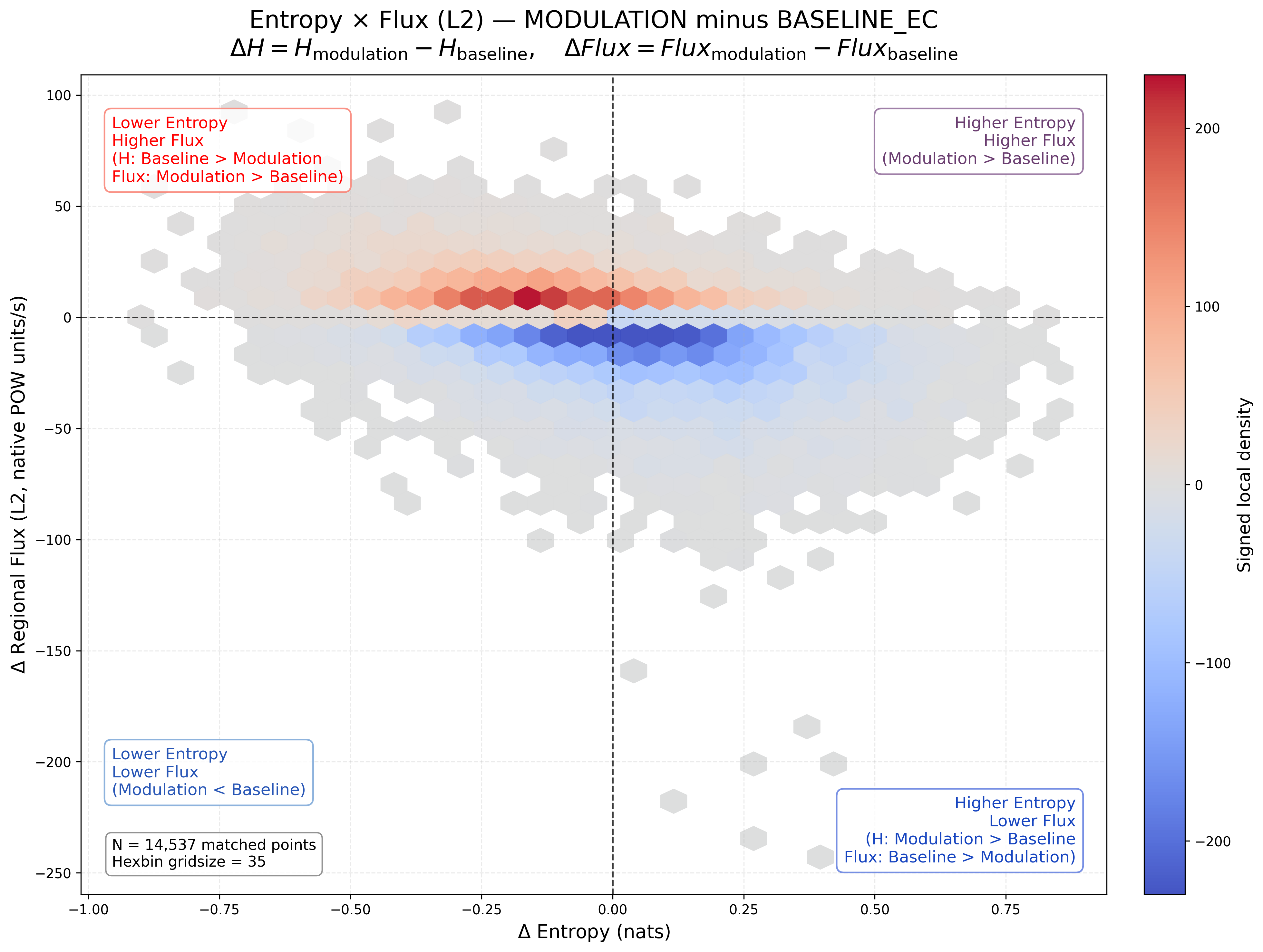
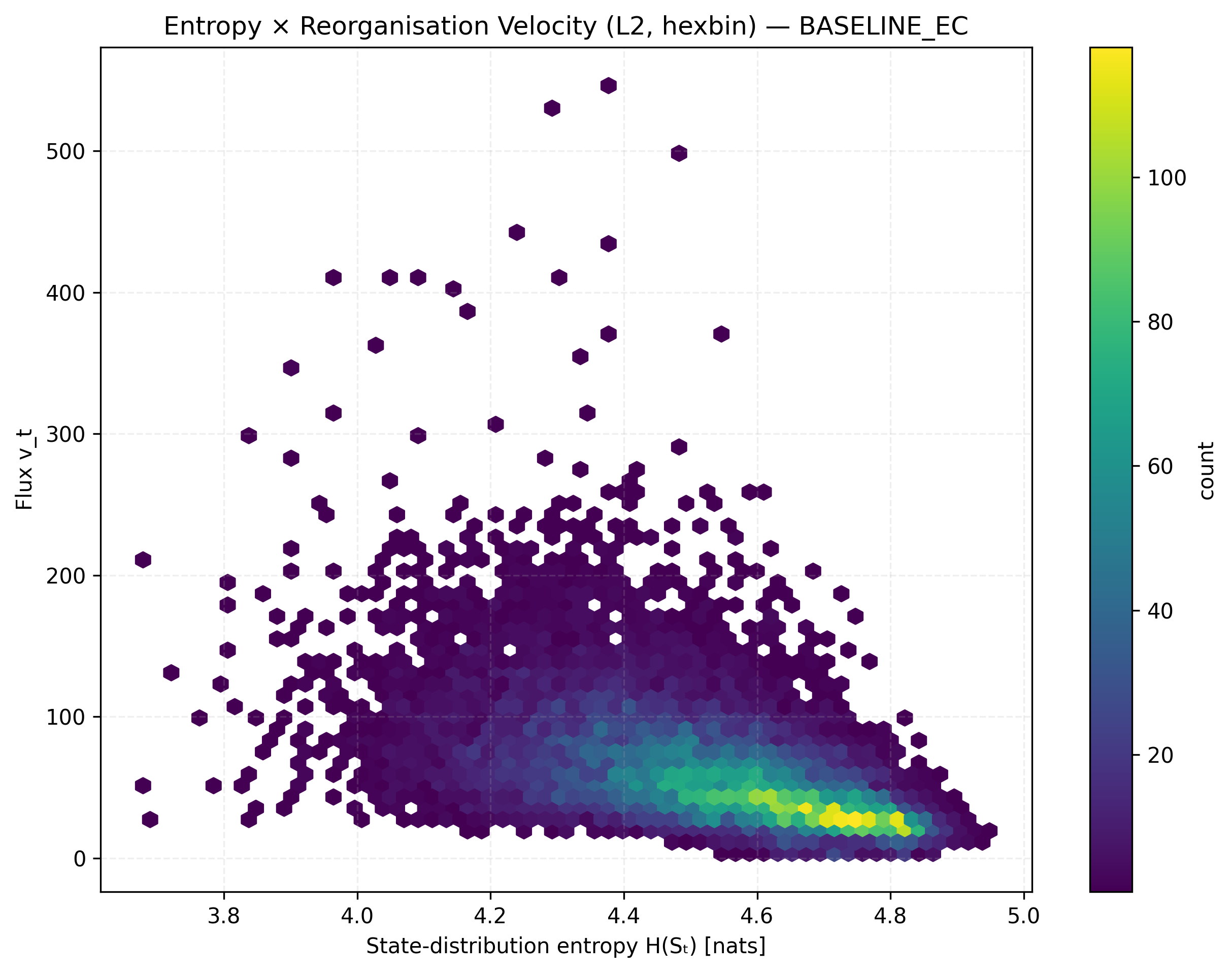
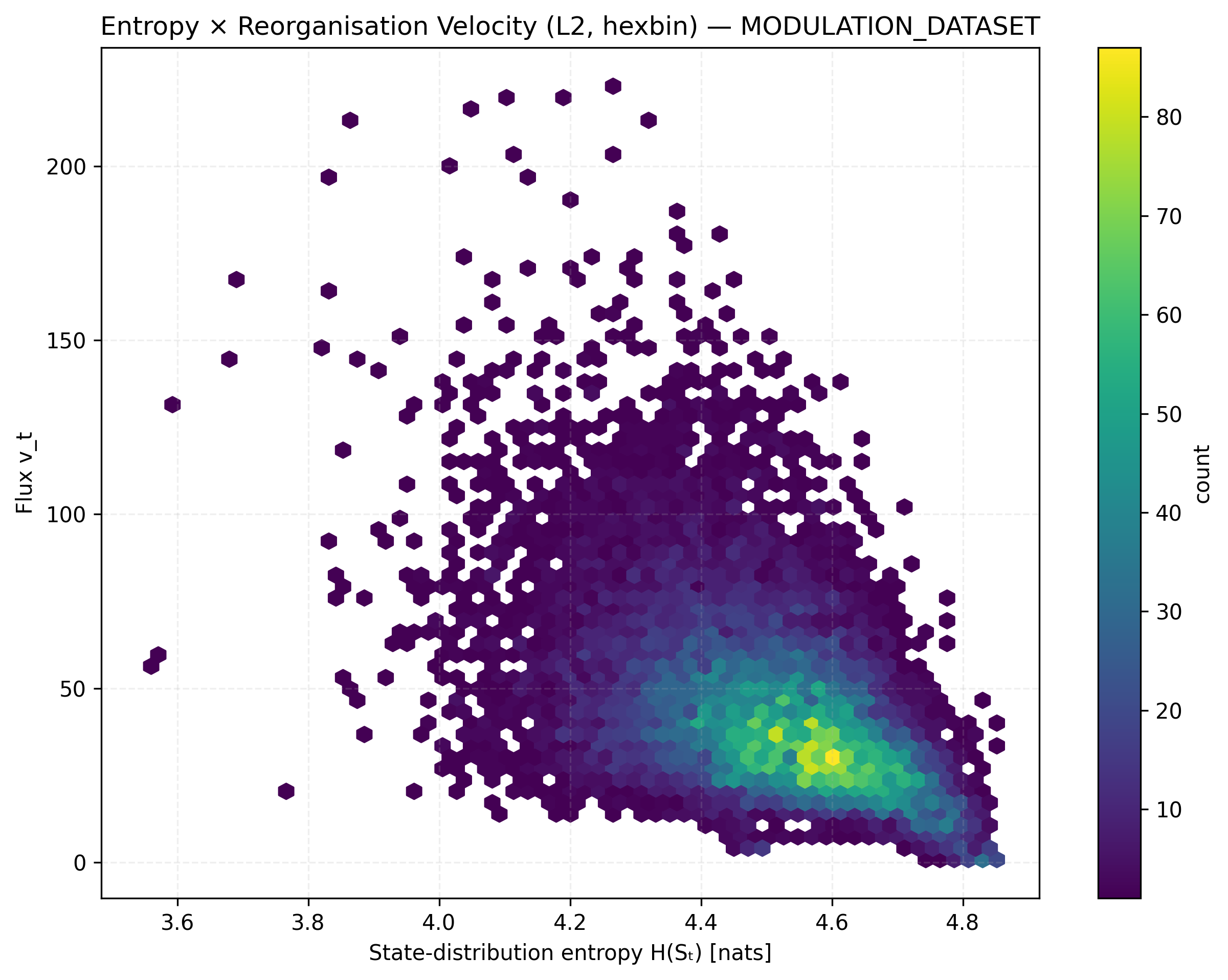
Relationship between state-distribution entropy and L2 reorganisation velocity during baseline (left) and modulation (right). Hexagonal binning illustrates the density of observations. Both conditions preserve a broadly similar entropy–flux relationship, with higher-entropy states generally associated with smaller state-space transitions. Under modulation, the observed distribution of reorganisation velocity appears more compressed relative to baseline, with fewer large state transitions while low-flux dynamics remain strongly represented. This suggests that modulation altered how the existing dynamical landscape was occupied rather than eliminating ongoing state evolution. The figures presented here illustrate representative examples of the observed dynamical changes. The complete analysis comprised dozens of complementary visualisations, including bandwise, regional, temporal, and state-space representations. To maintain readability, the full figure set and source CSVs are provided in the accompanying GitHub repository linked at the end of this article, which serves as a technical appendix supporting the results presented here.
The figures presented here illustrate representative examples of the observed dynamical changes. The complete analysis comprised dozens of complementary visualisations, including bandwise, regional, temporal, and state-space representations. To maintain readability, the full figure set and source CSVs are provided in an accompanying GitHub repository as a technical appendix supporting the results presented here.
For the purposes of this Influence Warfare paper, the key point is not the technical novelty of any single metric. The key point is that the processing landscape changed. If influence signals are received by a nervous system whose coordination, variability, persistence, and transition dynamics have shifted, then the same external information packet – a meme, warning, humiliation cue, threat narrative, image, rumour, or trusted message – may be weighted, filtered, encoded, and acted upon differently. The spectral evidence therefore supports a state-dependent model of influence: narratives perturb brain state, and brain state conditions the meaning and behavioural force of narratives.
This interpretation also sets a boundary. The present analysis does not, by itself, identify the subjective content of experience or prove how a specific message was processed. To make that stronger claim, future work would need stimulus-locked designs, behavioural measures, subjective reports, and repeated recordings. Accordingly, the EEG material is framed as a pilot demonstration of operating-regime change, with charts and CSVs best hosted externally as a technical appendix rather than embedded heavily inside the paper.
Narratives do not exert influence independently; they do so only through the biological systems that perceive, predict, and act upon them. In this sense, narratives are one mechanism by which cognitive state is perturbed and behaviour ultimately emerges.
Building Cognitive Resilience
If influence warfare targets cognitive state, resilience cannot be reduced to fact-checking. Facts remain essential, but they arrive too late if the target is already exhausted, enraged, humiliated, isolated, or identity-threatened. Resilience must therefore protect the governor: attention, salience, uncertainty tolerance, emotional regulation, and trusted interpretation networks.
At the individual level, resilience includes metacognition, source awareness, deliberate delay before sharing, sleep protection, stress regulation, and the ability to notice when a signal is attempting to move the body before it moves belief. At the organisational level, resilience requires rapid crisis communication, identity verification, insider-threat controls, transparent provenance, pre-bunking, and trusted messengers who can speak before adversaries fill the vacuum. At the societal level, resilience depends on plural trusted networks, civic education, local journalism, institutional competence, and norms that reduce humiliation while preserving accountability.
The course concepts of consonance and resonance are useful for defence. A resilient campaign does not need to manufacture artificial unity. It can identify stabilising networks already in consonance with democratic, civic, or institutional goals and then amplify them without over-owning them. The U.S. and Vatican support for Solidarity illustrates this principle: effective influence strengthened an indigenous network rather than making it appear externally controlled (Clark, 2026). Defensive influence should often enable favourable state transitions already present within society.
The final defensive lesson is subtle but critical: do not feed the adversary's activation loop. Overcorrection, censorship panic, public humiliation, or blanket accusations can validate the hostile narrative and deepen identity fusion. The aim is not to win every narrative exchange. The aim is to maintain functional cognitive states under pressure, preserve trust where it is deserved, expose deception without amplifying it unnecessarily, and keep populations capable of updating models without collapsing into cynicism.
Conclusion
Cognitive state manipulation does not mean direct control over belief. It means shaping the operating conditions under which signals are noticed, weighted, interpreted, remembered, and converted into action. The exploratory spectral analysis supports this framing by showing that modulation can alter the organisation of cortical dynamics without requiring the paper to become a neuroscience paper.
Modern influence warfare is not only a contest over narratives. It is a contest over the conditions in which narratives become perception, emotion, identity, and behaviour. Narratives still matter, but they operate through networks, subconscious learning, limbic salience, subtle delivery, and plastic biological systems. The practical question for analysts is therefore: what state is being engineered, through which signals, in which environment, by which networks, and with what expected behavioural actuator?
The frontier of the field lies in connecting the social and biological layers without collapsing one into the other. Russia, China, Iran, and North Korea demonstrate different operational styles, but all exploit the same basic vulnerability: humans do not process information as detached observers. They process signals as embodied, social, predictive systems trying to reduce uncertainty, preserve identity, manage threat, and maintain belonging. Influence defence must therefore become state defence: protecting the capacity of individuals, institutions, and societies to remain adaptive under engineered cognitive pressure.
Technical Appendix
Supplementary Material
The analyses presented in the exploratory EEG section are supported by an accompanying repository containing processing, spectral analyses, figures, and methodological documentation:
The Line Group Ltd – Influence Warfare: Neural State Reorganisation GitHub Repository
References
Associated Press. (2024, May 16). Justice Dept. makes arrests in North Korean identity theft scheme involving thousands of IT workers. https://apnews.com/article/0fb3e47dcc9a6f671b1fb7c0a722b1a8
Atran, S. (2010). Talking to the enemy: Faith, brotherhood, and the (un)making of terrorists. Ecco.
Barrett, L. F. (2017). The theory of constructed emotion: An active inference account of interoception and categorization. Social Cognitive and Affective Neuroscience, 12(1), 1-23.
Bastos, A. M., Usrey, W. M., Adams, R. A., Mangun, G. R., Fries, P., & Friston, K. J. (2012). Canonical microcircuits for predictive coding. Neuron, 76(4), 695-711.
Berns, G. S., Bell, E., Capra, C. M., Prietula, M. J., Moore, S., Anderson, B., Ginges, J., & Atran, S. (2012). The price of your soul: Neural evidence for the non-utilitarian representation of sacred values. Philosophical Transactions of the Royal Society B, 367(1589), 754-762.
Brady, W. J., Wills, J. A., Jost, J. T., Tucker, J. A., & Van Bavel, J. J. (2017). Emotion shapes the diffusion of moralized content in social networks. Proceedings of the National Academy of Sciences, 114(28), 7313-7318.
Business Insider. (2026, June 10). OpenAI says a suspected China-linked influence operation tried to sway the debate about US data centers. https://www.businessinsider.com/openai-china-data-centers-influence-campaign-2026-6
Clark, A. (2013). Whatever next? Predictive brains, situated agents, and the future of cognitive science. Behavioral and Brain Sciences, 36(3), 181-204.
Clark, H. (2026). Influence Warfare Volume II: The Invisible Hand. Influence Warfare Certificate Program.
Corbetta, M., & Shulman, G. L. (2002). Control of goal-directed and stimulus-driven attention in the brain. Nature Reviews Neuroscience, 3, 201-215.
Crockett, M. J. (2017). Moral outrage in the digital age. Nature Human Behaviour, 1, 769-771.
Crockett, M. J., Clark, L., Tabibnia, G., Lieberman, M. D., & Robbins, T. W. (2008). Serotonin modulates behavioral reactions to unfairness. Science, 320(5884), 1739.
Freedman, L. (2013). Strategy: A history. Oxford University Press.
Friston, K. (2010). The free-energy principle: A unified brain theory? Nature Reviews Neuroscience, 11, 127-138.
Goldstein, J. A., Sastry, G., Musser, M., DiResta, R., Gentzel, M., & Sedova, K. (2023). Generative language models and automated influence operations: Emerging threats and potential mitigations. arXiv. https://arxiv.org/abs/2301.04246
Graphika. (2024). The #Americans: Chinese state-linked influence operation Spamouflage masquerades as U.S. voters to push divisive online narratives ahead of 2024 election.
Kautilya. (2016). Kautilya's Arthashastra (R. Shamasastry, Trans.). CreateSpace Independent Publishing Platform.
Knill, D. C., & Pouget, A. (2004). The Bayesian brain: The role of uncertainty in neural coding and computation. Trends in Neurosciences, 27(12), 712-719.
McEwen, B. S. (2007). Physiology and neurobiology of stress and adaptation: Central role of the brain. Physiological Reviews, 87(3), 873-904.
Menon, V., & Uddin, L. Q. (2010). Saliency, switching, attention and control: A network model of insula function. Brain Structure and Function, 214, 655-667.
Mercier, H. (2020). Not born yesterday: The science of who we trust and what we believe. Princeton University Press.
Microsoft Threat Analysis Center. (2024). Nation-states engage in U.S.-focused influence operations ahead of U.S. presidential election.
Microsoft Threat Analysis Center. (2024). MTAC Election Report 5: Foreign influence activity around the 2024 U.S. election.
Musashi, M. (2018). The Book of Five Rings and other works (A. Bennett, Trans.). Tuttle Publishing.
OpenAI. (2024). AI and covert influence operations: Latest trends.
Politico. (2024, October 23). Influence campaigns from Iran, China, Russia ramping up ahead of elections, Microsoft finds. https://www.politico.com/news/2024/10/23/influence-iran-china-russia-elections-microsoft-00185075
Posner, M. I., & Petersen, S. E. (1990). The attention system of the human brain. Annual Review of Neuroscience, 13, 25-42.
Schultz, W., Dayan, P., & Montague, P. R. (1997). A neural substrate of prediction and reward. Science, 275(5306), 1593-1599.
TechRadar. (2026, June 18). Experts uncover another massive North Korean fake IT worker scam network. https://www.techradar.com/pro/security/these-actors-are-no-longer-relying-solely-on-traditional-cybercrime-experts-uncover-another-massive-north-korean-fake-it-worker-scam-network
The Guardian. (2024, May 30). OpenAI says Russian and Israeli groups used its tools to spread disinformation. https://www.theguardian.com/technology/article/2024/may/30/openai-disinformation-russia-israel-china-iran
The Guardian. (2024, December 3). Meta says it has taken down about 20 covert influence operations in 2024. https://www.theguardian.com/technology/2024/dec/03/meta-says-it-has-taken-down-about-20-covert-influence-operations-in-2024
U.S. Department of Justice. (2024, September 4). Two RT employees indicted for covertly funding and directing U.S. company that published thousands of videos in furtherance of Russian interests.
U.S. Office of the Director of National Intelligence, Federal Bureau of Investigation, & Cybersecurity and Infrastructure Security Agency. (2024). Joint statements on Russian and Iranian election influence activity.
Vosoughi, S., Roy, D., & Aral, S. (2018). The spread of true and false news online. Science, 359(6380), 1146-1151.
Weatherford, J. (2004). Genghis Khan and the making of the modern world. Three Rivers Press.
Zuboff, S. (2019). The age of surveillance capitalism. PublicAffairs.
Bassett, D. S., & Sporns, O. (2017). Network neuroscience. Nature Neuroscience, 20(3), 353-364.
Cohen, M. X. (2014). Analyzing neural time series data: Theory and practice. MIT Press.
Nunez, P. L., & Srinivasan, R. (2006). Electric fields of the brain: The neurophysics of EEG (2nd ed.). Oxford University Press.
Shannon, C. E. (1948). A mathematical theory of communication. Bell System Technical Journal, 27, 379-423, 623-656.
This article forms part of The Line Group Ltd's ongoing research into influence systems, cognitive security, and neural state dynamics.
— The Line Group Ltd
01 September 2026
Download Paper: Influence Warfare Beyond Narratives: Cognitive State Manipulation in the Attention Age (PDF)